Trouble reading this email? Read it on the web →
This Week's Fire Weather
A mild close to August: no fire weather watches or warnings in effect for the East Bay interior as of Sunday, highs in the upper 60s to mid 70s through midweek, a steady southwest breeze, and cool nights in the low 50s. Air quality is forecast in the Good range across the Eastern Zone with no Spare the Air alerts. If you're home for the Labor Day weekend, it's a comfortable window for yard work; the story below is a good reason to spend some of it on your go bag instead.
Sources: NWS forecast for Orinda · Spare the Air 5-day forecast
The Week Reno Had to Leave
The Hawk Fire started Saturday, August 22 in the Sierra foothills near the California line and blew up the next day, burning through dry sagebrush and grass into the edge of Reno's neighborhoods. At its peak, more than 90,000 people were under evacuation orders or warnings, 42,000 of them told to go immediately. By Monday's briefing, at least 32 homes had burned, at least seven people were hurt, and officials expected the damage count to rise as assessment teams reached the burned blocks. The fire was human-caused, the third large human-caused fire north of Reno in two weeks.
The details that matter for us are the small ones. Residents described having minutes, not hours. One woman who returned for her belongings told the Associated Press, "I just got what I thought I needed." The main evacuation shelter at the Reno-Sparks Convention Center couldn't take pets; animals had to go to separate drop-off locations across town, one more decision for families already improvising on their worst day. None of that is unique to Reno. A packed go bag, a route you've actually driven, and a pet plan settled in advance are the difference between leaving and scrambling.
→ Evacuation Routes for Lamorinda: your primary and backup ways out, neighborhood by neighborhood · The 72-Hour Go Bag Build · Pet Evacuation: Getting Your Animals Out Safely
Sources: Associated Press via NBC News (Aug. 24, 2026) · The Guardian (Aug. 23, 2026) · PBS NewsHour / AP (Aug. 23, 2026)
Community Bulletin
How does an evacuation alert actually reach your phone? Contra Costa County's Government Speak podcast just devoted an episode to exactly that. The Community Warning System team, including CWS Manager Lorena Herrera and senior emergency planners Richard Beeson and Leslie Monroy, walks through what happens behind the scenes before an alert goes out, who has the authority to send one, and how agencies coordinate during an incident. One episode turns the alert on your phone from a mystery into a system you understand. Listen to the episode → Then make sure every channel is switched on for your household with our Emergency Alert & Warning Systems playbook.
MOFD updated its emergency spending rules. At its August 19 meeting, the MOFD board adopted Ordinance 26-06, an update to the district's purchasing and contracting procedures. Most of it is administrative housekeeping, but one piece is worth knowing about: it authorizes the board to establish, by resolution, procedures for contracting repairs and spending district funds immediately during a major emergency when action is needed to protect life, property, and critical infrastructure. In plain terms, the district is tightening the machinery it would rely on when minutes count. The ordinance takes effect 30 days after passage; the full text is on MOFD's ordinances page.
Sources: City of Lafayette Weekly Roundup (Aug. 28, 2026) · MOFD Notice of Adoption (Aug. 28, 2026)
One Thing to Do This Week
Grab a seat in the fall CERT class before it fills. The Lamorinda Community Emergency Response Team's fall series starts Tuesday, September 15 at the Lafayette Community Center and runs Tuesday evenings, 6:30 to 9:30 p.m., through November 10. The curriculum is the practical backbone of everything this newsletter covers: home preparedness, fire safety, disaster medical response, light search and rescue, radio communications, and pet preparedness. It's taught by neighbors, for neighbors, and the city notes spaces are filling fast. If the Hawk Fire story above left you wondering how ready your household really is, this is the most concrete answer available in Lamorinda this fall. Register online →
→ Strength in Numbers: why prepared neighbors are the best fire protection · The Neighborhood Communication Playbook
Source: City of Lafayette Weekly Roundup (Aug. 28, 2026)
Where to Start if You're New Here
The best first step is to check your fire hazard zone. Our Home Fire Readiness Score is not open yet; the same page lets you join the list and we will let you know when it is. After that:
- The Big Three: roof, vents, and defensible space: the highest-priority moves for a Lamorinda home
- Gold Protocol: what to do each week from now through October
- Home Hardening Checklist: the full walk-around list of upgrades that make a home ember-resistant
Correction, October 11, 2026: this issue, as sent, labeled the link to our fire hazard zone check as the Home Fire Readiness Score and called it a 10-minute self-assessment. The Home Fire Readiness Score is not open yet, so this web copy now describes the link accurately.
If a neighbor forwarded this to you and you'd like future issues, sign up here.
Lamorinda Ready is a community education resource. This newsletter is for general educational and informational purposes only and does not constitute legal, insurance, financial, construction, or emergency response advice. Hawk Fire figures (acreage, containment, structures, evacuation counts) are as reported by the Associated Press and officials at the August 24, 2026 briefing and will have changed since; consult official incident sources for current status. Always consult qualified professionals and official agencies (MOFD, ConFire, your city) before making decisions about your home or property. Content available through links in this newsletter is subject to the same limitations.
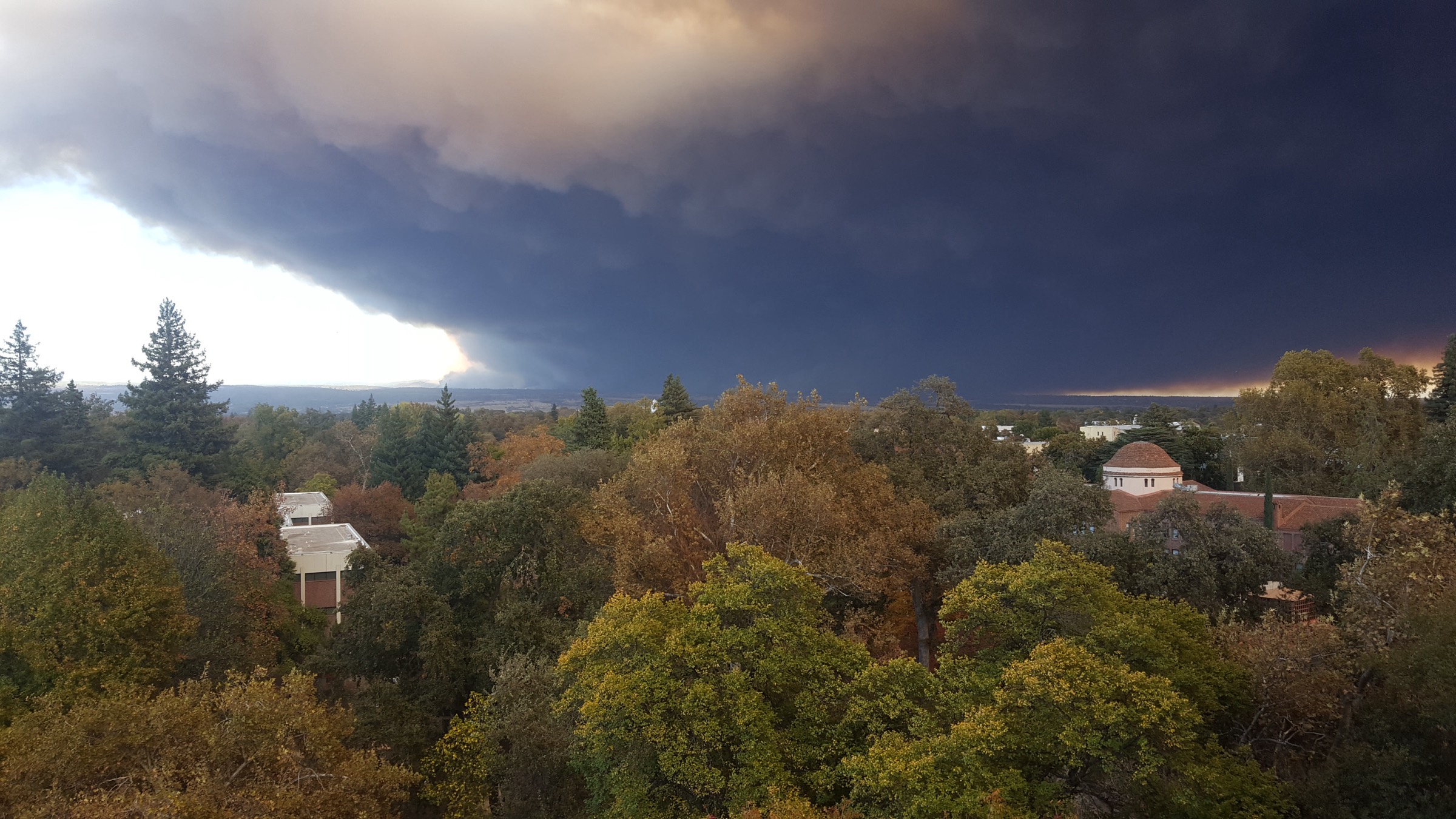
Header photo: the Camp Fire's smoke column over Chico, California on the morning of November 8, 2018, as vehicles evacuated from Paradise, by Test Subject 51, via Wikimedia Commons, CC BY-SA 4.0.

Lamorinda Ready
Practical resilience for Lafayette, Moraga, and Orinda.
1480 Moraga Rd Ste C #188, Moraga, CA 94556