Update, October 11, 2026: A clarification to the note below, which is about the state's Zone 0 rules. The Moraga-Orinda Fire District has its own. MOFD's fire ordinance (Ordinance 23-03, adopted in February 2023 per MOFD's ordinance list) already sets Zone 0 requirements for the first five feet around structures on parcels in Moraga and Orinda, and they apply regardless of what the state does. In the ordinance text, owners "shall" meet them. They include keeping combustible ground cover such as mulch and bark out of the area within two feet of a structure (gravel, pavers and concrete are fine), no stored firewood, lumber or other combustible material in Zone 0, no Monterey pines or eucalyptus there, six feet of clearance under branches that overhang the roof, and roof and gutters kept free of leaves and needles. The wording and exceptions are MOFD's to interpret; see MOFD's published abatement requirements and the text of Ordinance 23-03 (a copy posted on the City of Orinda's site), or ask MOFD's Fire Prevention Office. Lafayette is served by ConFire, so ask ConFire what applies there.
Update, October 3, 2026: The Zone 0 rules described below are not in effect. After the Board adopted them on August 19, it filed them with the state Office of Administrative Law (OAL) on August 28. OAL's public log lists that filing as withdrawn on September 8, 2026, and as of October 3 no Zone 0 filing appears on OAL's list of emergency regulations under review. The Board's Zone 0 page says it continues to work with OAL on a final review. No effective date has been set, and the requirements may change before the rules are finalized. The five-foot work described here is still sound ember protection; for what applies to your property today, call MOFD's Fire Prevention Office (Moraga and Orinda) or ConFire (Lafayette).
Since March, we have been telling you the same thing about the first five feet around your home: it is the most consequential fire-safety real estate you own. On Wednesday, August 19, the Board of Forestry and Fire Protection voted unanimously to adopt first-in-the-nation "Zone 0" regulations. Once they take effect, they would set enforceable standards for the zero-to-five-foot ember-resistant zone around homes and structures in the state's highest fire hazard areas.
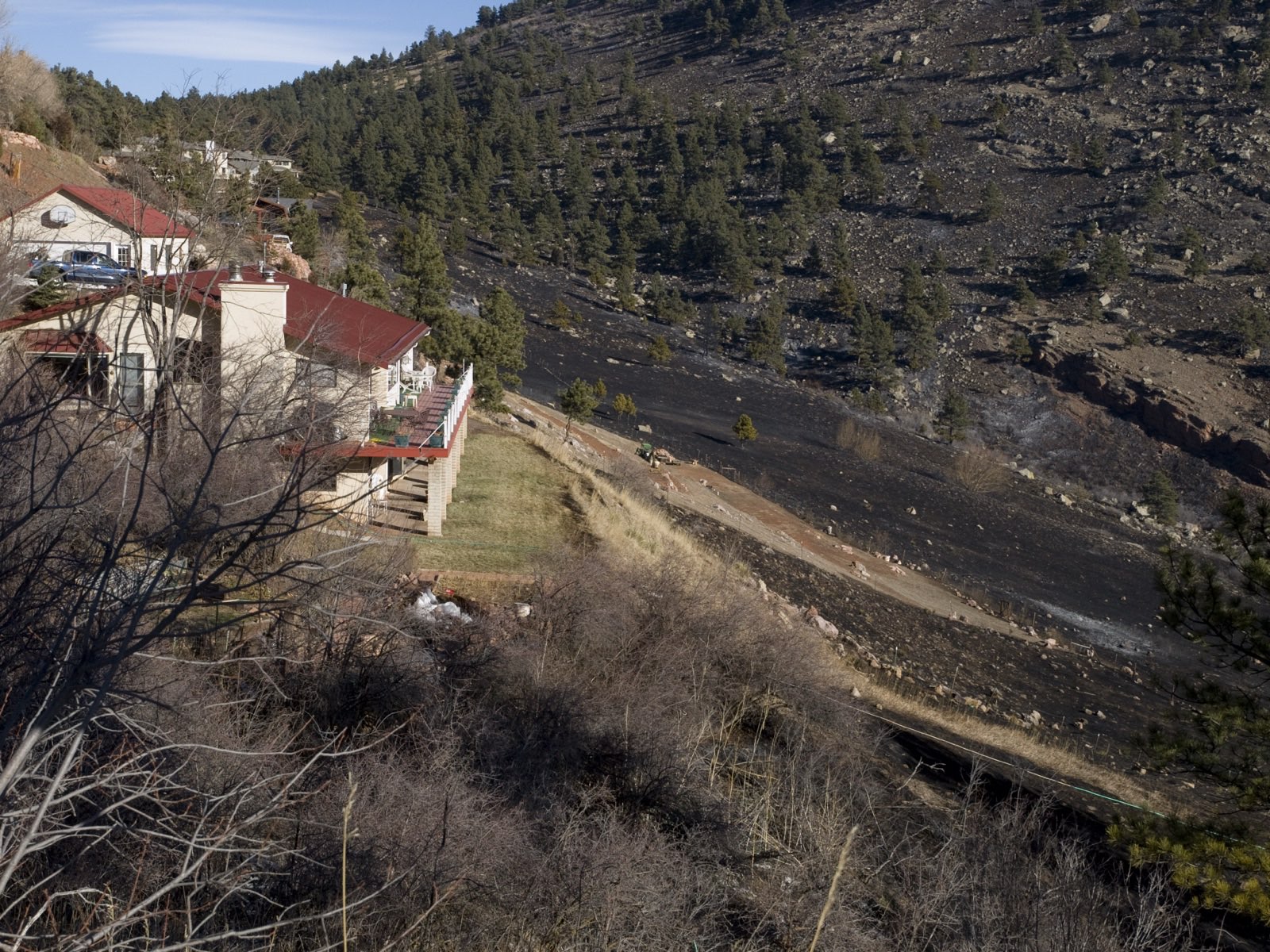 Homes near Boulder, Colorado after the 2009 Old Stage Fire. Defensible space around the houses gave firefighters room to work, and the homes survived. Photo: Michael Rieger / FEMA, public domain.
If you have been following our coverage, this is the next step in a long process. Back in April, when Moraga and Orinda ratified MOFD's updated fire and WUI codes, we noted that Zone Zero was still pending at the state level. MOFD Deputy Fire Chief Lucas Lambert put it plainly at the time: "We are at the mercy of the process, and currently the process holds with the Board of Forestry." The Board's vote concluded its part of that process, and the rest of the process is still underway. Here is what the Board adopted, and what it would mean for your household.
What was adopted
The adopted regulation would create enforceable standards for Zone 0, the first five feet around a structure, in response to a consistent research finding: most homes lost in wildfires ignite not from a wall of flame but from wind-blown embers that land in the material closest to the house. In the Board's announcement, State Fire Marshal Daniel Berlant pointed to the same research finding: homes are at their most vulnerable to embers within the first five feet.
The rulemaking traces back to AB 3074, passed in 2020, which required the Board to establish an ember-resistant zone in the first five feet. SB 504 refined the mandate in 2024, and Governor Newsom's Executive Order N-18-25 directed the Board to accelerate the work after the Los Angeles fires in January 2025. The Board's advisory committee spent 2025 and 2026 working through drafts and public workshops before Wednesday's unanimous vote.
Who the rules apply to
The regulations apply to homes in two categories:
- The State Responsibility Area (SRA), where CAL FIRE has primary responsibility for wildfire protection
- Very High Fire Hazard Severity Zones in Local Responsibility Areas (LRA), which is where most affected Lamorinda properties fall
Large portions of Lafayette, Moraga, and Orinda carry Very High designations on the state's hazard maps, and some outlying areas are SRA. Whether the rules would apply to your parcel depends on your zone designation, not your fire district. You can check your address on the Office of the State Fire Marshal's Fire Hazard Severity Zone maps. The San Francisco Chronicle reports the rules will eventually reach nearly 2 million California homes.
What the rules would require
As adopted, the regulation would divide the first five feet into two nested areas. Immediately against the house, and under the eaves, is a non-combustible "safety zone" whose width flexes with your eave depth: one-foot eaves mean a one-foot safety zone, two-foot eaves mean two feet. The rest of the five feet is a low-combustibility zone with strict limits on what can be there.
The headline requirements in the adopted text:
- No combustible materials in Zone 0. Firewood, bark mulch, wood chips, dead leaves, and dead or dying vegetation are out, including on roofs and in gutters.
- Vegetation buffers around openings. No vegetation within two feet of windows, doors, and vents, or within five feet of attached decks.
- Plants are allowed, with conditions. Well-maintained herbaceous plants and flowers, low ground covers, maintained lawn, and potted plants in movable non-combustible containers can stay outside the buffer areas.
- Trees are allowed, with maintenance. Branches must be kept ten feet from chimneys, trimmed five feet above roofs, and out from under eaves, with ladder fuels removed.
- Fences and gates. Where a fence attaches to the house, a five-foot non-combustible section is required. No new combustible fences or gates may be built in Zone 0, though repairs to existing ones are allowed.
- Sheds and outbuildings within Zone 0 need non-combustible exterior roofs and walls.
If that list sounds familiar, it should. It is close kin to the Zone 0 guidance we published in March and the priorities in The Big Three. The state did not invent new science here; it codified what the research on ember ignition has shown for years.
The timeline is longer than the headlines suggest
This is the part worth reading carefully, because the regulation is deliberately gradual for existing homes:
- New construction must comply once the regulation formally takes effect.
- Phase 1, within the first three years: the housekeeping layer. Remove combustible items like firewood, mulch, and dead vegetation from the five-foot zone, clean gutters, and trim trees to the standards.
- Phase 2, within five years: the construction layer. Local jurisdictions will set timelines for the under-eave safety zone, replacing combustible gates, and bringing sheds and fencing into compliance.
The Board says implementation will prioritize education and outreach over the five-year phase-in. Two procedural steps remain before the rules could take legal effect: review by the Office of Administrative Law, which includes a short public comment window, and filing with the Secretary of State. (As the update at the top explains, the August 28 filing was later withdrawn.) All of the deadlines above would run from that effective date, so there is no state Zone 0 rule in force today. That is separate from MOFD's local Zone 0 rules for Moraga and Orinda, described in the October 11 update above and in the next section.
What happens locally
State adoption is not the last word, and the state's rules are not the only rules. In MOFD territory, the district's own fire ordinance (Ordinance 23-03, adopted in February 2023) already sets Zone 0 requirements for the first five feet, and MOFD's defensible space inspections look at that zone today. What a state regulation would add is a statewide floor and a phase-in timeline. As Deputy Chief Lambert noted in January, it will be at the purview of MOFD's board to adopt or amend whatever the state finalizes.
Lafayette homeowners are served by ConFire rather than MOFD, but the state regulation applies by hazard zone designation, not by district. The City of Lafayette highlighted the new rules in its August 21 Weekly Roundup, an early sign that local guidance is on the way.
Two honest caveats. First, how each agency will fold Zone 0 into its inspection and enforcement practice is not yet published; if you have a specific compliance question, MOFD's Fire Prevention Office (for Moraga and Orinda) or ConFire (for Lafayette) is the authoritative source. Second, the phase timelines above are from the Board's adoption announcement; the operative dates will be set when the regulation is filed and takes effect.
Our take: the first five feet are worth doing now
If the rules are finalized as adopted, the phase-in would give existing homes years to comply, because retrofitting nearly two million homes takes time. But embers do not honor phase-in schedules, and October fire weather does not care when a rule takes effect. The homeowners who will find any final rule painless are the ones who treat the first five feet as a checklist starting this fall.
The good news is that the housekeeping layer is mostly a weekend, not a construction project. Walk the perimeter, move the woodpile, rake out the bark mulch, pull the dead plants, clean the gutters. Our Zero-Foot Perimeter guide has the priority checklist, and the defensible space zones playbook shows how Zone 0 fits the full 0-1-2 system. When you get to the structural items, the detach-your-wood-fence playbook covers the highest-value structural move, swapping the fence section that touches your house for something that will not carry flame to your wall.
And there is a byproduct worth knowing about: the same first-five-feet work is one of the components insurers recognize under the state's Safer from Wildfires framework, which we cover in our insurance navigation playbook. Do the resilience work for your home and family; let the insurance conversation get easier as a result.
If you are not sure where to start, begin with the fire zone check. Our Home Fire Readiness Score, which will help you see whether your five-foot zone, your roof, or your vents is the gap that matters most, is not open yet; you can join the list on that page.
Continue Learning
Playbooks
- The Big Three: Roof, Vents, and Defensible Space
- Defensible Space Zones: The 0-1-2 System
- Detach Your Wood Fence from the House
- Home Hardening Checklist
Insights
- The Zero-Foot Perimeter: Lamorinda's New Line of Defense
- What MOFD's New Fire and WUI Codes Mean for Your Next Project
- MOFD Inspections: What to Expect
Sources: Board of Forestry & Fire Protection announcement of Zone 0 adoption (Aug. 19, 2026) · BOF Defensible Space Zones page (statutory background and meeting materials) · City of Lafayette Weekly Roundup, Aug. 21, 2026 · OSFM Fire Hazard Severity Zones · AB 3074 (2020) · SB 504 (2024) · Lamorinda Weekly, March 11, 2026 (Lambert quote, via our April coverage)
This article is published by Lamorinda Ready for educational and informational purposes only. It does not constitute legal, construction, insurance, or professional advice. The Zone 0 regulation described here was adopted by the Board of Forestry and Fire Protection on August 19, 2026 but as of August 23, 2026 had not yet completed Office of Administrative Law review or been filed with the Secretary of State; requirements and effective dates may be refined in that process. Local implementation in MOFD and ConFire jurisdictions is not yet published. Consult MOFD, ConFire, your city building department, and qualified professionals before making decisions about your home or property.